Vocal Performance in Mexico: A Biomechanical Guide to Singing Without Strain
Mastering vocal performance in Mexico comes down to neuromuscular coordination—the balance between the thyroarytenoid (TA) muscles, which govern vocal fold body and mass, and the cricothyroid (CT) muscles, which elongate them for pitch—combined with precise acoustic vocal tract coupling. It is never achieved by pushing breath or relying on laryngeal hyperfunction. This biomechanical principle is what allows a singer to sustain the raw cry of mariachi, the intimacy of a bolero, or the punch of modern pop without neck constriction or ending up hoarse: acoustic power and emotional intensity come from acoustic resonance tuning and efficient glottal closure, completely dismantling airflow pushing as a vocal strategy.
At my studio in Naucalpan (and in my online sessions with international singers and expats across Mexico City), I constantly work with professional vocalists and musical theatre actors who are frustrated by the same misconception. They believe that delivering the intensity required on Mexican stages means accepting burning neck tension or hoarseness. That is a serious mistake: feeling pain, strain, or fatigue after singing is never normal. Stage authenticity is not an abstract feeling, nor is it an excuse to trash your larynx. Authenticity is sustainable physical function. If your body has to compensate to hit a note or convey an emotion, there is no real freedom—only muscular strain disguised as passion.
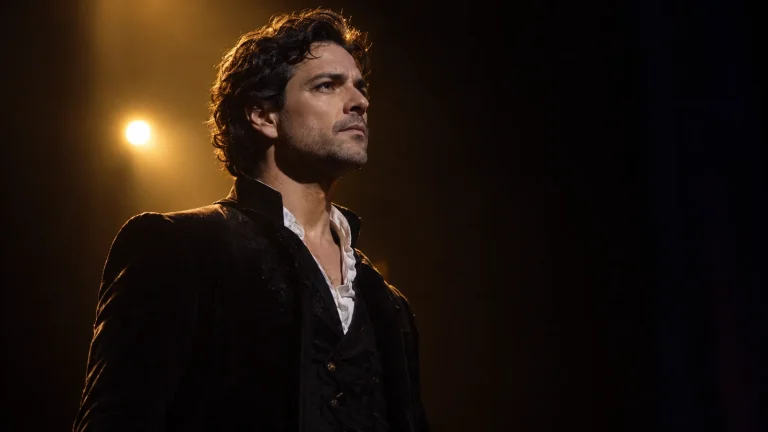
I am always direct with my clients: I am not a medical doctor, and I am not a licensed physiotherapist. I am a vocal coach with training in applied laryngeal physiotherapy for singing and voice, trained internationally in manual vocal therapy and applied vocology (The Voice Care Centre UK, MVT). Yes, I teach and coach fluently in English. I have spent over 20 years as an actor and singer in professional musical theatre in Mexico City—in productions like The Phantom of the Opera and Las Meninas—and I still perform weekly on stage. I know firsthand what it feels like to sing with a tired body in the third week of a run, doing eight shows a week alongside punishing rehearsals. Whether you work with English musical theatre repertoire, Mexican traditional genres, or commercial music, this guide shows you how to connect vocal technique and artistic expression through vocal biomechanics, so you can sing with power and emotion without destroying your instrument.

Why Mexican Repertoire Demands Neuromuscular Stamina, Not Brute Force
The Mexican vocal tradition is unlike any other in the world. Our stage culture demands raw, visceral commitment. Audiences expect the vulnerability of the bolero, the fierce tear of mariachi, or the rhythmic punch of contemporary Latin pop. The breakdown happens when singers confuse emotional surrender with laryngeal hyperfunction. As I break down in my master guide to vocal performance in Mexico, our repertoire requires methodical neuromuscular stamina that very few singers ever learn to build correctly.
Diverse Genres: From Bolero to Mariachi and Pop
In Mexico, singers rarely stay confined to a single style. In my daily practice, I see artists who perform an intimate set of boleros on Friday, front a full mariachi ensemble with trumpets blaring behind their ears on Saturday, and tackle musical theatre or commercial pop on Sunday. They are genuine vocal athletes. Each of these styles demands completely distinct vocal tract configurations:
- The Bolero: Demands microscopic control over thin vocal fold mass, subtle airflow management, and a warm acoustic timbre with moderate subglottic pressure.
- Mariachi and Regional Mexican: Demands an intense, bright acoustic output driven by chest-dominant or high-intensity mixed voice (what the industry often calls a belting or ‘gritón’ style). Without precise acoustic resonance balancing, this genre can destroy vocal folds within months.
- Contemporary Pop: Requires fluid transitions into mixed voice, melismatic agility, and precise acoustic management calibrated for the microphone.
The most common mistake among singers switching between these genres is applying the same breath-pushing mechanics to everything. You cannot approach a son jarocho or a huapango with the same vocal fold mass you use for a romantic ballad. Learning how to adjust vocal tract length and internal pharyngeal space is what allows you to cross styles without accumulating chronic vocal fatigue.
Phrasing and Diction in Mexican Stage Culture
Mexican Spanish features a distinct phonetic articulation: it is highly consonantal, rhythmic, and marked by closed vowels in colloquial speech. In singing, this is a double-edged sword. If you import spoken speech patterns directly without formant tuning, stop and dental consonants (like /t/, /d/, and /p/) drive harsh pressure collisions straight into the glottis.
Performing in Mexico requires immaculate text clarity without letting articulation lock up the larynx. In the studio, I regularly see singers clenching their jaw and the root of their tongue to ‘articulate clearly.’ That extrinsic muscular tension pulls the hyoid bone down against the thyroid cartilage, jamming the natural laryngeal tilt you need to navigate pitch shifts. Diction must remain light and agile. You do not deliver text by clamping the jaw; you project it by tuning the internal dimensions of your vocal tract.
The Evolution of Vocal Technique on the Modern Stage
For decades, a damaging myth dominated Mexican singing: that singers are simply born with talent in their throats and that ‘learning technique’ strips away raw feeling. This belief has wrecked careers midway through. Remarkable vocalists find themselves unable to access their upper register by age 35 because of fibrotic tissue accumulated from years of brute-force singing.
Fortunately, the performing arts landscape in Mexico is shifting. Today, musical theatre performers, session vocalists, and traditional singers understand that technique is not a rigid classical mold that makes you sound sterile. It is the structural framework that gives you true freedom. Biomechanical training does not homogenize your tone; it strips away muscular interference so your authentic timbre and emotional delivery emerge without mechanical resistance.
Emotion as a Neuromuscular Reflex: Singing Drama Without Strangling the Larynx
Too many vocal teachers tell students: ‘just feel the song and the voice will follow.’ That is terrible advice. When you experience intense emotion, your body triggers automatic tension patterns that are often phonation’s worst enemy. Applying biomechanical strategies to vocal interpretation lets us examine what physically occurs when dramatic tension enters the equation.
The Limbic System and Sound Production
The larynx evolved primarily as a sphincter designed to protect the airway; phonation is a secondary, adapted function. The limbic system—the neural circuitry governing fear, grief, rage, and attachment—has direct pathways to the intrinsic and extrinsic laryngeal muscles. When you act out a dramatic scene or sing a piece loaded with sorrow, your nervous system initiates protective reflexes:
- The larynx elevates in preparation to swallow or yell.
- The middle and inferior pharyngeal constrictors contract, collapsing your resonating space.
- The floor of the mouth (mylohyoid, digastric) and neck musculature lock up.
If you are not conscious of this reflex, that emotional commitment strangles the larynx. The singer feels deeply invested, but the audience hears a constricted, off-pitch tone stripped of acoustic harmonics. In my studio, I have seen profound emotional releases during manual therapy: singers carrying deep hyperfunctional holding patterns they were not even aware of. When we release those trigger points using external and intraoral myofascial techniques, the larynx lowers, internal space opens up, and emotion rings out with genuine power rather than strain.
Neuromuscular Coordination for Dynamic Nuance
Dynamic range and vocal colors do not come from muscular effort; they come from coordination between two main muscle groups inside the larynx: the thyroarytenoid (TA) muscles, which govern vocal fold thickness and depth, and the cricothyroid (CT) muscles, which lengthen and thin the vocal folds for higher pitches. Artistic expression is essentially the neuromuscular ability to adjust the TA-to-CT engagement ratio within milliseconds while maintaining clean glottal closure.
If you want to transition from a delicate, intimate line to a commanding climax, your vocal folds must adjust without triggering secondary neck muscles. Without that coordination, you default to compensation: clenching the jaw or slamming breath against the cords. Interpretive flexibility requires your neuromuscular system to execute musical commands without recruiting unnecessary auxiliary muscles.
How Body Posture Supports Expressive Freedom
The voice does not start in the throat; it operates within a full biomechanical chain. An anterior pelvic tilt, lumbar hyperextension, or forward head posture immediately alters fascial tension around the larynx. The hyoid bone is suspended by over a dozen muscles anchoring into the jaw, cranium, scapulae, and sternum.
When a singer locks into a rigid posture to ‘look confident,’ or slouches to ‘look vulnerable,’ they distort the vertical axis of the vocal tract. True expressive freedom requires a body that is mechanically available: unlocked knees, an expandable rib cage, and an unburdened shoulder girdle. Stage authenticity is physical function: when the body compensates, interpretation disappears, leaving only mechanical struggle.
Dynamic Control: Projecting Volume Through Resonance, Not Air Pushing
Dynamic control separates the beginner from the seasoned professional. Anyone can sing loudly by blasting air; the real craft lies in singing a piano or pianissimo that retains brilliance, acoustic presence, and immaculate pitch. To master this range, using science-backed vocal performance techniques is essential.
Techniques to Vary Volume Without Sacrificing Timbre
Perceived acoustic volume does not come from blowing more air. In fact, overblowing is the fastest way to blow the vocal folds apart, creating either a breathy tone or a damaging glottal shock. Volume depends on two biomechanical drivers:
- Closed Quotient (Glottal Contact Time): The percentage of each vibratory cycle that the vocal folds remain closed. A longer, cleaner closure transfers significantly more acoustic energy into the air.
- Acoustic Coupling of the Vocal Tract: How effectively you shape your pharynx and oral cavity so that sound waves amplify passively through acoustic resonance.
To sing softly without losing core color or intonation, you must maintain firm vocal fold contact while subtly reducing airflow. If you drop glottal closure under the assumption that singing quietly means whispering, the larynx loses stability. The sound must keep its acoustic core regardless of volume.
The Truth About ‘Diaphragmatic Support’ in Singing
We need to dismantle one of singing’s most damaging myths: so-called ‘diaphragmatic support.’ I have spent years repeating this to my students: you do not sing with your diaphragm. The diaphragm is strictly an inspiratory muscle under involuntary control. When you inhale, it contracts and lowers like a flattening parachute, allowing air into the lungs. The moment you begin to exhale, speak, or sing, the diaphragm relaxes and ascends to its natural dome shape.
You cannot consciously control your diaphragm during phonation. When a coach tells a singer to ‘squeeze the diaphragm’ or ‘push from the stomach,’ all the singer does is violently clench their rectus abdominis muscles. That sudden abdominal pressure spike forces the larynx upward, locks the floor of the mouth, and chokes off free vocal fold vibration. If you want to sing well, leave your diaphragm alone.
What vocal pedagogy misnames ‘support’ is actually breath column stability—the precise balance between subglottic pressure from the lungs and the myoelastic resistance of the vocal folds. When you disrupt that balance by pushing with your abdominal wall, the voice breaks, goes sharp or flat, or suffers injury.
Managing Air Pressure for Subtle Dynamics
To simplify this biomechanical rule in the studio, I use a familiar Mexican guideline—the one taught across the country for earthquake safety:
- Don’t run (No corro): Respect the timing of both music and phonation. Do not rush to attack a note before your vocal tract is properly positioned.
- Don’t shout (No grito): Do not inflate volume or drop the jaw excessively to reach an upper note. High notes are solved through acoustic tuning and vocal fold mass transitions, not raw volume.
- Don’t push (No empujo): This is the golden rule. If subglottic pressure (air accumulated beneath the cords) is excessive and violent, the collision impact on the vocal fold mucosa is brutal. Over time, that continuous pounding leads to swelling, fatigue, and structural issues like nodules or polyps.
Delivering subtle dynamics onstage demands a steady, laminar flow of air—free from aggressive abdominal surges.
Iconic Styles: Technical Adaptation by Genre
The beauty of Mexican music lies in its contrasts. You cannot apply a one-size-fits-all formula to radically different genres. If you want a technical guide to vocal performance tailored to our repertoire, you must understand how to adjust vocal tract geometry for each specific style.
The Melancholic, Technical Phrasing of the Bolero
The Mexican bolero (immortalized by composers like María Grever, Agustín Lara, and Álvaro Carrillo) does not tolerate brute force. It requires elastic, intimate phrasing with exquisite rubato. Biomechanically, the bolero is built on:
- A stable, neutral larynx: Minimal vertical shifting, maintaining a consistent tonal color across the mid-range.
- Low-to-moderate subglottic pressure: Allowing smooth transitions from modal voice into lightened mix without sudden register breaks.
- Resonance centered in the oral and pharyngeal cavities: Delivering warm harmonics without the harshness of high-pressure singing.
In a bolero, emotional weight rests on clean consonantal articulation and the ability to sustain a pitch with natural, unforced vibrato. When the singer stops clenching the abdomen and constricting the neck, vibrato emerges organically as a byproduct of balanced tissue physiology.
Projection and Power in Mariachi
Mariachi and regional Mexican music place relentless physical demands on the singer. In these styles, the vocalist competes acoustically against live trumpets, violins, and vihuelas, frequently without adequate stage monitoring in open-air venues and palenques. It is a demanding, high-intensity style that will destroy an untrained voice.
To sing mariachi sustainably, the key is acoustic resonance, not raw output:
- Formant Tuning: The singer must learn to narrow the epilaryngeal tube (engaging the singer’s formant cluster or ‘twang’). This creates an enormous acoustic boost around 2.5 to 3.5 kHz, allowing the voice to cut through the instruments without screaming.
- Vocal Tract Alignment: In the studio, we use manual therapy to release extrinsic muscle tension and create internal pharyngeal space. Opening that internal space amplifies the sound naturally.
- The Traditional Falsetto: The signature falsete of the huapango or canción vernácula requires instantaneous decompression of the thyroarytenoid muscle, allowing the vocal fold edges to vibrate freely as the cricothyroid elongates. If you slam air pressure into that register shift, the transition stumbles and sounds clumsy.
Fluidity and Technique in Contemporary Mexican Pop
Pop music produced in Mexico blends traditional lyricism with urban grooves, Anglo-American pop balladry, and electronic production. The voice must be exceptionally flexible. Modern pop vocalists must master a contemporary commercial mix: a coordination that sounds like a powerful chest belt in the upper range while mechanically relying on reduced vocal fold mass and tightly controlled airflow.
The priority here is agility. Pop does not use the darker depth of mariachi or the languid warmth of the bolero; it demands forward acoustic placement, an active soft palate to alternate between clear oral tones and stylish commercial resonance, and a gentle glottal onset to withstand grueling multi-hour studio sessions.
Vocal Health and Fatigue Prevention in Performance
No artistic intention justifies ending a performance without a voice. Vocal health is non-negotiable for a working professional. Anyone who romanticizes hoarseness by claiming that ‘losing your voice proves you gave your all’ does not understand human physiology. In my vocal coaching sessions in Mexico City and at my Naucalpan studio, the first step is always eliminating the habits that drive chronic inflammation.
Identifying Unnecessary Muscle Tension
When an exhausted singer comes to my studio, my first priority is assessing how their instrument moves. Vocal fatigue rarely originates in the vocal folds themselves; it stems from surrounding muscular compensations. The three most common holding patterns that derail performance are:
- Temporomandibular Joint (TMJ) and Masseter Tension: Clenching the jaw on high notes or during articulation, which immobilizes the larynx.
- Tongue Root Retraction: Pulling the tongue back into the pharynx to artificially darken the tone, which chokes resonance space and forces the larynx to compensate with increased air pressure.
- Suprahyoid Hyperactivity: The muscles beneath the chin hardening like rock during phonation. If you can feel hard tension under your jaw while singing, you are compensating.
Managing Fatigue After Demanding Performances
Singers doing eight shows a week in musical theatre or touring concert circuits are high-performance vocal athletes. If you run a marathon, your legs need structured muscular recovery; your larynx requires the exact same care.
It is vital to distinguish between dysphonia (difficulty phonating due to mucosal swelling or fatigue, marked by air leaks or pitch breaks) and aphonia (complete voice loss). Transient fatigue after a heavy weekend of shows recovers with rest, endogenous hydration (drinking water steadily throughout the day), and exogenous hydration (saline nebulization). However, when dysphonia becomes recurrent or lasts longer than ten days, the protocol changes immediately. I am always uncompromising on this point: I am not a medical doctor. If chronic dysphonia is present, an evaluation by an ENT / laryngologist or phoniatrician with videostroboscopy is mandatory before continuing vocal training. If an injury is confirmed, I work hand in hand with that specialist, from their diagnosis and with their clearance. My work is vocal habilitation — building function — never rehabilitation of injured tissue, which is theirs to lead. I do not guess at pathologies: I work from the medical diagnosis your ENT or phoniatrician provides.
Recovery Exercises and Body Awareness
To restore balance after an intense vocal performance, generic scales are a complete waste of time. Your larynx needs to return to its resting baseline through decompression:
- Semi-Occluded Vocal Tract Exercises (SOVT): Phonation through a straw or Lax Vox tube into water, or sustained voiced fricatives and lip trills (/rr/, /m/, trills). These exercises generate positive backpressure in the vocal tract, expanding the pharyngeal walls and gently separating the vocal fold margins. This produces low-impact phonation that reduces swelling and resets neuromuscular balance.
- Laryngeal Mobilization and Gentle Stretch: Gentle manual gliding of the thyroid cartilage and myofascial massage of the sternocleidomastoid (SCM), scalenes, and suprahyoid muscles to release accumulated stage tension.
- Proprioceptive Reset: Re-anchoring your breath mechanics without abdominal squeezing, reconnecting to physical balance and neutral posture.
Artistic authenticity on Mexican stages is not achieved by pushing past pain. It is built on a precise functional assessment, targeted manual release, and disciplined neuromuscular retraining. When your technique supports your biology, you can sing with raw passion, night after night, while keeping your voice completely intact.
Sources and further reading
- NIDCD (National Institutes of Health) — Taking Care of Your Voice
- American Speech-Language-Hearing Association — Voice Disorders
- The Voice Foundation — Understanding Voice Production
- NIDCD — Vocal Fold Paralysis
- The Voice Care Centre (UK) — where I trained in manual laryngeal work
- Modern Vocal Training — my Advanced Vocal Coach certification